Bourdon Manometer Explained: How the Dial Pressure Gauge Works
TL;DR: A bourdon manometer is an analogue pressure gauge that uses a curved metal (Bourdon) tube: as pressure rises, the tube tries to straighten, and a linkage turns that tiny movement into a pointer sweeping a dial. It is robust, needs no batteries and suits medium and higher pressures, which is why you still see bourdon dials on cylinders, compressors and boiler bodies. For the low-millibar readings a Gas Safe engineer takes on a boiler, though, a dial is coarse and easy to misread — so most trainees end up learning on a dial but carrying a digital manometer for actual test work.
Key takeaways
- A bourdon manometer converts pressure into pointer movement using a springy curved tube — purely mechanical, no power needed.
- It shines at medium/high pressure and rough environments; it is weak at the low mbar range that domestic gas work lives in.
- On an ACS course it helps to understand the dial, then read mbar directly on a digital tester for boiler and tightness work.
- A good first digital tester sits under £150 and reads the same pressures far more precisely.
What is a bourdon manometer?
The Bourdon tube was patented by Eugène Bourdon in 1849 and is still the most common mechanism inside analogue pressure gauges. Inside the case is a flattened metal tube bent into a C-shape (or a coil). One end is sealed and free to move; the other is fixed to the pressure connection. When gas or liquid pressure enters, the flattened tube tries to become round and, in doing so, uncurls very slightly. A small gear-and-lever movement multiplies that motion and swings the pointer across the printed scale.
Because the whole thing is mechanical, a bourdon manometer needs no batteries and keeps working in cold, damp or dusty places. That durability is exactly why you meet them early: they are the gauge on the side of a nitrogen cylinder, an air compressor or a plant-room header.
Where a bourdon dial still fits
- Medium and high pressures — cylinder regulators, compressed air and hydraulic lines, where the scale spans many bar and a dial is perfectly readable.
- Permanent monitoring — mounted on plant so anyone can glance at system pressure without a tool in hand.
- Rugged sites — no display to fail, no battery to go flat in a cold van overnight.
Why a dial struggles with domestic gas work
UK domestic natural gas runs at a working pressure of only about 20–21 mbar at the meter outlet (the IGEM/G/13 acceptable band is 18.5–23 mbar). That is a tiny slice of pressure. On a bourdon dial calibrated in bar or high mbar, 20 mbar is a whisker of needle movement, and in a dim airing cupboard, parallax — reading the needle from an angle — introduces error before you have even written anything down.
This is the moment most trainees ask the honest question: what manometer does a Gas Safe engineer actually need? For inlet and burner pressure checks, and for a gas tightness test, you want to read millibars directly, with resolution fine enough to see small changes. That is a digital job.
Your first tester on an ACS course
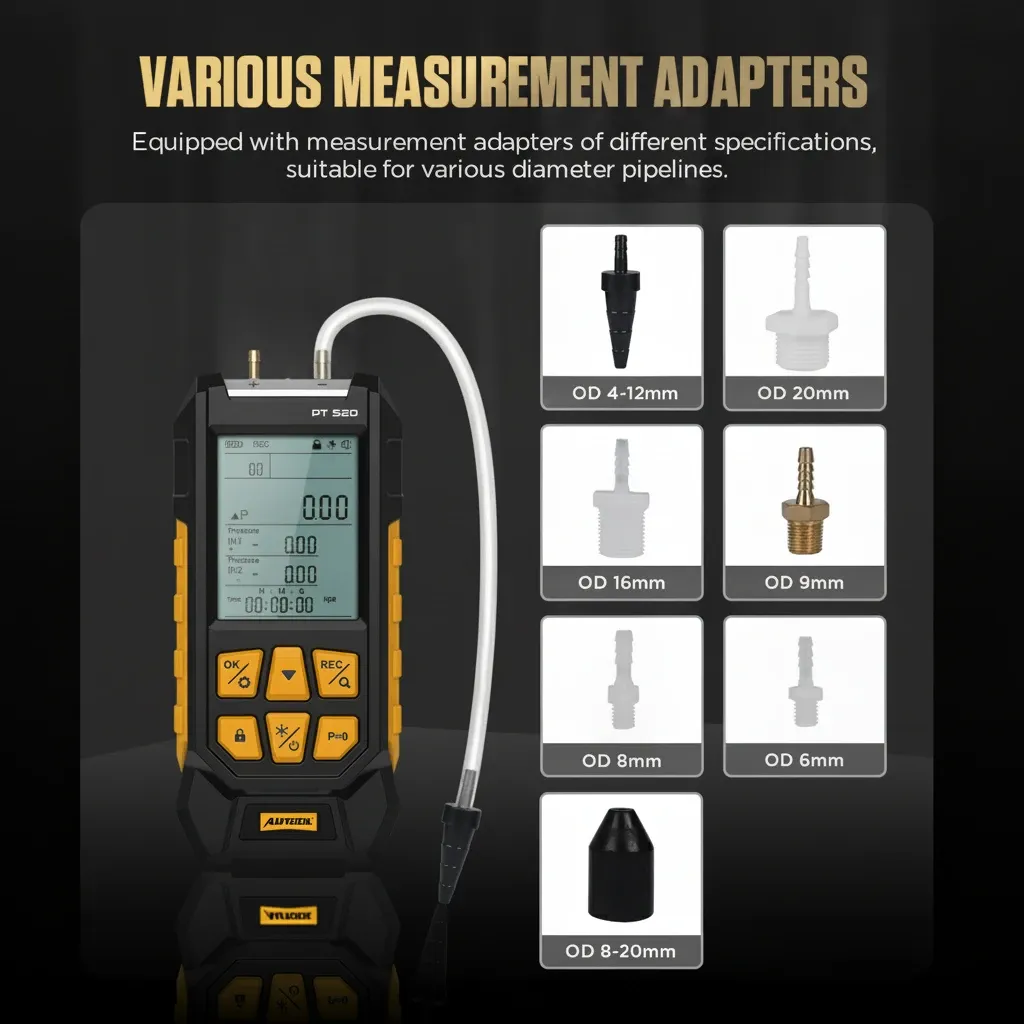
If you are buying your first instrument for training and site days, understanding the bourdon dial is worth an afternoon — it explains what a gauge is doing — but your working tool will almost certainly be a digital differential manometer. A ManometerGas digital gas manometer reads mbar directly, has two ports (P1 and P2) so you can practise differential checks, and includes ZERO to null the reading after connecting hoses and HOLD to freeze a value while your hands are busy. At £121.15 it sits under the £150 most trainees budget for a first tester, and ships with the silicone hose and fittings you need for practice.
When you are ready to compare instruments properly, our gas pressure tester buying guide and our digital pressure gauge explainer walk through accuracy and resolution without the jargon.
Frequently asked questions
Is a bourdon manometer the same as a manometer?
"Manometer" is a general word for a pressure-measuring instrument. A bourdon manometer is the analogue type that uses a Bourdon tube and a dial. A digital manometer measures the same thing electronically and shows a number.
Can I use a bourdon gauge for a boiler tightness test?
It is not ideal. Domestic gas sits around 20 mbar, and the small movements a tightness test looks for are hard to read on a dial. A digital manometer with fine resolution is the practical tool for that job.
Do I need to learn analogue gauges at all?
Understanding how a bourdon dial works helps you interpret any gauge and spot a faulty one, so it is useful background — but for recorded test readings, engineers use digital instruments.
Ready to upgrade your diagnostics with ManometerGas?
ManometerGas digital gas manometer — ±0.3% FS accuracy, -100~200 kPa range. Free UK delivery.
View the Digital Gas Manometer — £121.15