How to Choose a Gas Pressure Tester in the UK for a Heating Team
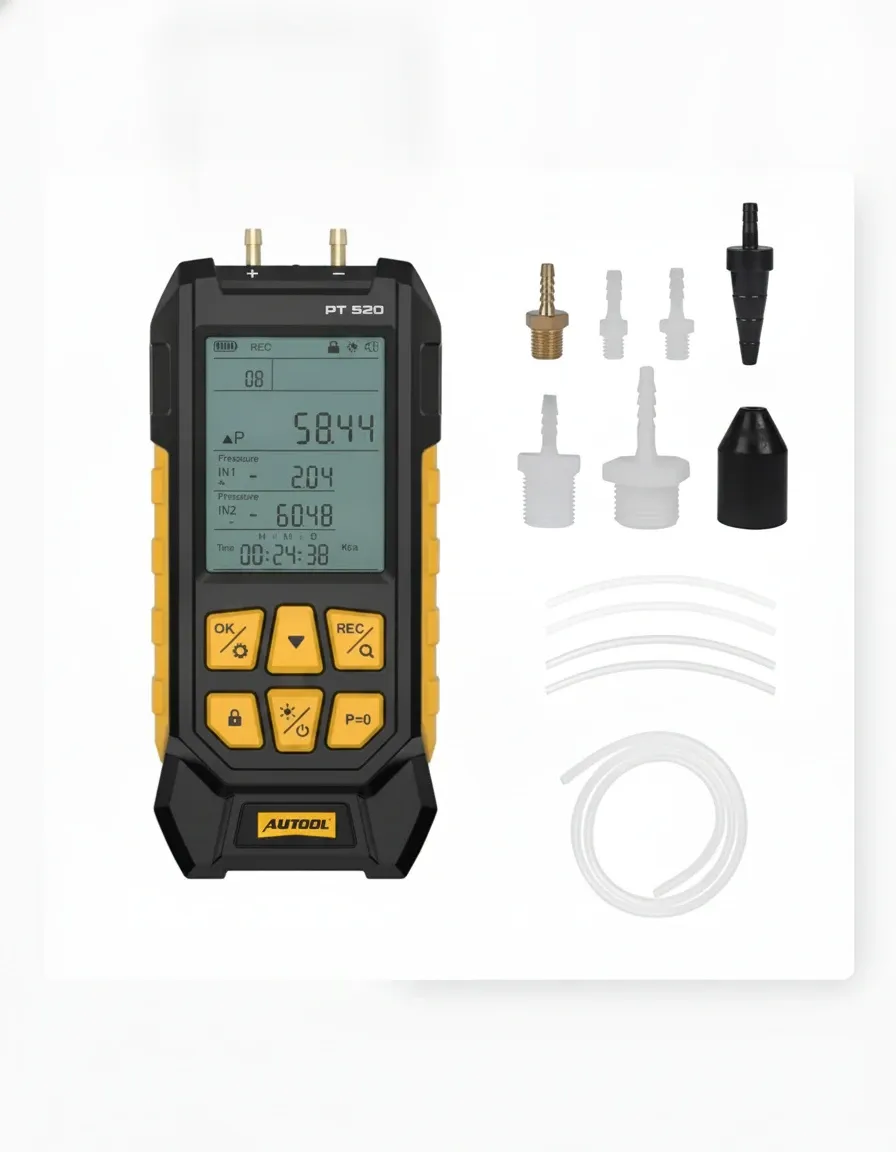
TL;DR: Choosing a gas pressure tester for a UK heating business is not about the most expensive instrument — it is about picking one model you can standardise across every engineer and van, so job sheets read the same and spares are interchangeable. Prioritise low-pressure resolution over headline range, a differential (P1/P2) capability, clear digital display, ZERO and HOLD, switchable units, and a supplier who quotes ex-VAT and turns warranties around quickly. For most domestic and light-commercial teams a ±0.3% FS differential manometer with a −100 to 200 kPa range, such as the ManometerGas digital gas manometer at £121.15, hits the practical sweet spot.
Key takeaways
- Standardise on one model across the team so readings, training and spare hoses are consistent.
- Judge testers on low-pressure resolution and a differential (P1/P2) mode, not just a wide range.
- Buy on ex-VAT cost, UK warranty turnaround and spare-part availability when kitting more than one van.
- ±0.3% FS with a −100 to 200 kPa range covers most domestic and light-commercial gas work.
What is a gas pressure tester?
A gas pressure tester (often just called a manometer in UK trade language) measures gas pressure in pipework and appliances. Unlike the fixed dial on a boiler that shows system water pressure, a portable tester lets you read at test points, compare inlet versus burner pressure, and carry out a gas tightness test on an isolated section. A differential unit reads two ports at once (P1 and P2), which is why it also handles duct and filter checks.
Choosing for a team, not just one engineer
Once a business has proven one unit in the field, the sensible next step is to standardise rather than let every engineer buy something different. Standardisation pays off in three ways:
- Consistent records — when everyone runs the same tester, your commissioning and service sheets read the same way, and a job can be picked up by a second engineer without re-interpreting the numbers.
- Interchangeable spares — one set of spare hoses and fittings covers the whole fleet, so a split hose does not strand an engineer for the day.
- Simple training — a new starter learns one workflow (connect, ZERO, read, HOLD) that applies to every van.
When you are buying several units — a main tester per engineer plus a spare in each van — the numbers that matter shift from a single headline price to the ex-VAT cost, the warranty turnaround if one fails mid-week, and whether you can reorder the exact same model in six months.
Key specifications to check
1. Pressure range and resolution
Domestic gas work sits at low pressure — around 20 mbar at the meter. A −100 to 200 kPa range covers standing, working and tightness readings, but the deciding factor is resolution at the low end. Ask for the resolution figure, not just the range, because that is where a tester is judged on real jobs.
2. Accuracy
±0.3% FS is a sensible class for trade work. Remember it is a full-scale figure — on a 200 kPa range that is roughly ±0.6 kPa (±6 mbar) in absolute terms — so pair it with good resolution for low-mbar readings. Our digital pressure gauge guide explains this in full.
3. Differential vs single-port
A differential manometer measures the pressure difference between two points, which a single-port gauge cannot do without extra kit. For versatility across gas and airside work, choose differential — see our differential pressure gauge guide.
4. Display, ZERO, HOLD and units
A clear backlit display, a ZERO function for honest differential readings after connecting hoses, HOLD to capture a value in an awkward space, and switchable units (mbar, kPa, inH2O) are the day-to-day features that save time. Auto power-off protects battery life on long van days.
5. Calibration and support
Check whether calibration guidance is provided and whether replacement hoses and fittings are stocked. An instrument you cannot maintain or recalibrate is a false economy across a fleet.
Features you can skip
- Industrial hydraulic ranges — a −100 to 200 kPa gas tester is not meant for hundreds-of-bar hydraulic work, and you do not need that range for boilers.
- Complex data-logging you will never open after a domestic call-out.
- App pairing that adds setup friction without improving the reading.
A practical standard for UK trade work
If you want one instrument that covers tightness testing, boiler diagnostics and HVAC differential readings across the team, a digital differential manometer in the ±0.3% FS class with a −100 to 200 kPa range is the practical choice. The ManometerGas digital gas manometer at £121.15 fits this profile, ships with silicone hose and fittings, free UK delivery, CE/UKCA marking, a 12-month UK warranty and 30-day returns — so you can trial one, then reorder the identical model for the rest of the fleet.
Frequently Asked Questions
Do I need a differential or single-port gas pressure tester?
For Gas Safe work a differential manometer is more versatile: it handles tightness testing and differential checks a single-port gauge cannot perform without extra equipment.
What accuracy do I need for boiler commissioning?
±0.3% FS or better is appropriate. The deciding factor is not just the headline figure but whether the instrument holds calibration and offers enough resolution at low pressure.
How much should I budget per tester for a team?
Trade-quality digital manometers for UK gas work typically sit between £100 and £200. Buying several, focus on the ex-VAT price, warranty turnaround and the ability to reorder the same model rather than the lowest sticker price.
Kitting out your team?
ManometerGas digital gas manometer — ±0.3% FS, −100 to 200 kPa, £121.15 with free UK delivery and a 12-month UK warranty.
Shop the Digital Gas Manometer