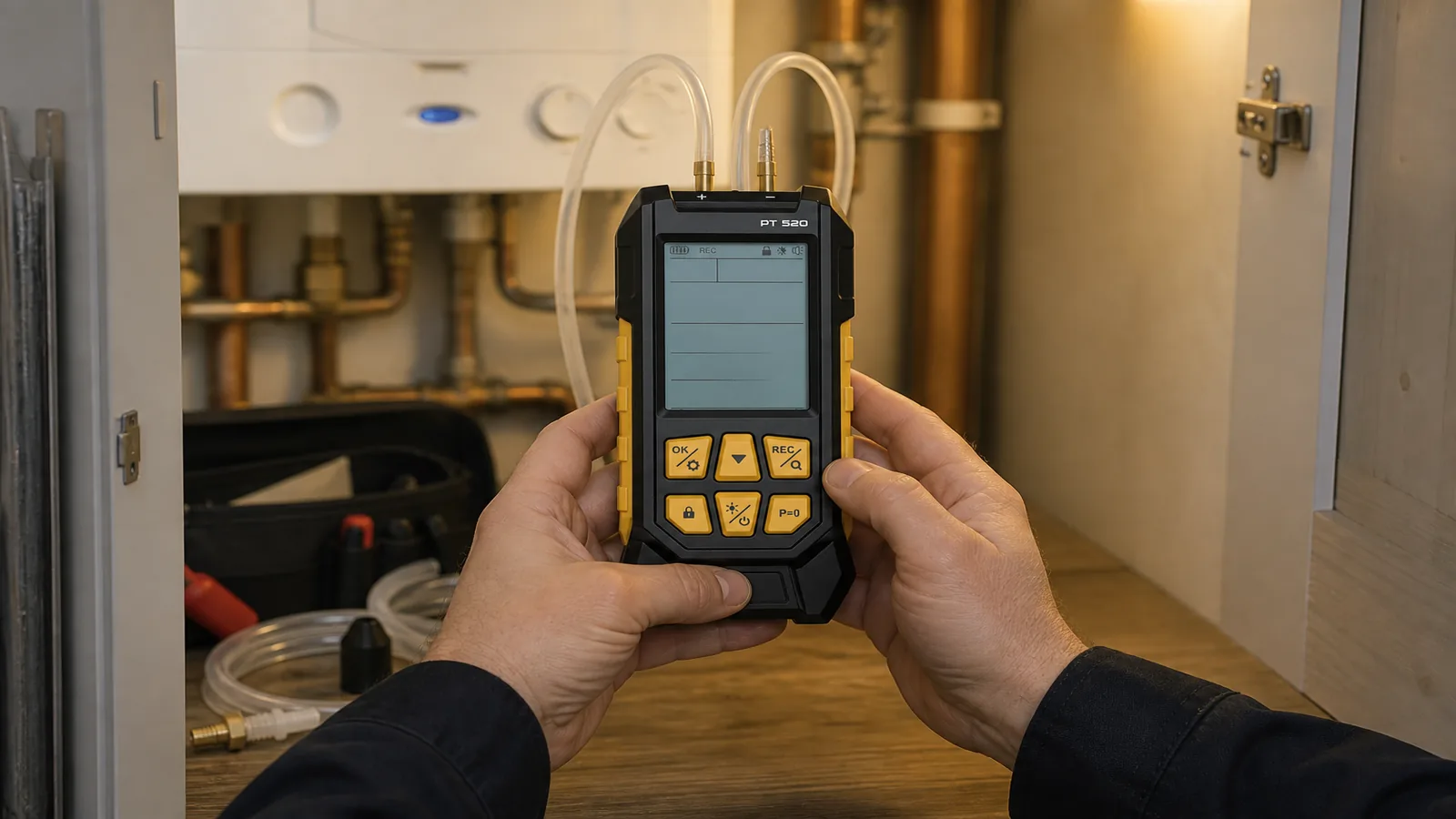
How to Zero a Digital Manometer Before Testing (UK Field Checklist)
How to zero a digital manometer before testing is straightforward: leave both ports open to atmosphere, allow a short warm-up, select the unit you will use, then zero the display so later differential readings start from a true atmospheric baseline—before any hose or appliance connection.
Why zeroing matters
A digital manometer reports pressure relative to the reference you set. If the zero is off, every subsequent differential reading can be biased, even when the hoses and ports are correct. Zeroing with both ports vented to room air establishes a shared atmospheric reference so gauge and vacuum-style differentials make sense when you convert between units later.
On a dual-port HVAC / gas differential tester such as the AUTOOL PT520 positioned on the UK product page, multi-unit display (including mbar, psi, kPa and inH2O among others) only helps if the zero was taken in the same unit and conditions you will use for the job.
Step-by-step zero routine
Use this digital manometer first use checklist UK sequence before any live system connection:
- Place the instrument on a stable surface away from draughts, heat sources and vibration.
- Confirm both pressure ports are open to atmosphere—no hoses fitted, or hoses disconnected and left open at the instrument end.
- Power on and allow a brief warm-up so the reading settles (warm up and zero check manometer HVAC habit).
- Select the display unit you will use for the test (for example mbar or kPa) and leave it unchanged until after zeroing.
- Run the instrument’s zero / null function as described in its manual until the display reads zero (or the nearest settled null the firmware shows).
- Watch the reading for a few seconds; if it drifts, repeat zero with ports still open to air before connecting anything.
Hose connection order
Only after a stable zero should you attach hoses. Typical safe first test with digital manometer UK order is:
- Fit hoses to the instrument ports first, keeping the free ends open to atmosphere while you check that zero has not shifted from handling.
- If zero moved when you touched the ports, remove or vent the hoses and zero again.
- Connect the free ends to the test points only when the display is still at your accepted null.
- For differential work, keep high/low (or P1/P2) orientation consistent with the procedure you are following; do not swap ports mid-test without re-checking zero at atmosphere.
Common zero errors
- Zeroing with one or both hoses already tied into a pressurised or partially sealed system.
- Changing units after zeroing and assuming the null still holds without a fresh atmosphere zero.
- Zeroing in a strong draught, in a hot vehicle, or while holding the case tightly enough to flex the ports.
- Treating listing accuracy wording as a substitute for a proper zero and a competent test method.
- Skipping a re-zero after changing batteries, fittings or moving between cold outdoor and warm indoor air.
When not to proceed (gas competence)
A manometer does not make the user Gas Safe registered. In Great Britain, gas work that legally requires a registered engineer must be carried out by someone who appears on the Gas Safe Register official list of registered engineers. If you are not competent and legally entitled to do the gas task, do not proceed beyond instrument familiarisation on atmosphere—stop and use a registered engineer.
Do not treat purchasing or owning a differential manometer as certification, and do not rely on unverified accuracy figures as a guarantee of safe gas commissioning.
Next step
If you need a dual-port digital gas / HVAC differential pressure tester with multi-unit readout and field-kit accessories for UK use, review the current product details for the AUTOOL PT520 listing (including the publicly stated free UK delivery and 12-month warranty wording on that page).
FAQ
Do I zero with hoses attached?
Zero with both sensing paths open to atmosphere. If hoses are fitted, their free ends must still vent to room air; otherwise remove them, zero, then connect in the order above.
Which unit should I choose before zeroing?
Pick the unit required by your procedure first (for example mbar or kPa). Pressure measurement practice uses coherent SI and related units when converting readings, so avoid switching units after the null without re-zeroing at atmosphere.
What range language appears for this dual-port tester?
Public listing language for the AUTOOL PT520 includes a −100~200 kPa span with multi-unit readout such as mbar, psi, kPa and inH2O among others. Treat that as product-page wording, not a substitute for on-site zero and competent method.
Can this tool replace a Gas Safe engineer?
No. Only Gas Safe registered engineers appear on the official register for gas work in Great Britain where registration is required.