Common Digital Manometer Mistakes UK Engineers Should Avoid
The most common digital manometer mistakes UK field teams make are choosing the wrong display unit, swapping differential ports, skipping a zero check, and reading leaks or heat effects as true pressure—errors that waste time and can lead to unsafe conclusions on gas and HVAC work.
Top mistakes ranked
Ranked by how often they spoil a reading before the job has properly started:
- Wrong units — treating mbar as kPa (or the reverse) on HVAC and gas checks.
- Swapped high/low ports — reversing the differential gauge connections so the sign and magnitude look plausible but are wrong.
- Forgetting to zero before a pressure test — carrying over offset from the last job or from hose residual pressure.
- Hose leaks and kinks — chasing a “fault” that is only in the test set-up.
- Overrange or heat soak — pushing the instrument beyond its listed working range or reading while the sensor is still thermally unstable.
- Crossing the DIY gas-work boundary — using a tool as a substitute for lawful gas competence.
Unit and port mix-ups
Wrong units: mbar vs kPa errors in HVAC
Digital gauges often switch freely between mbar, kPa, psi, inH2O and other scales. A reading that “looks right” in the wrong unit is still wrong. Confirm the selected unit against the procedure and any conversion you apply; pressure measurement literature covers gauge/vacuum concepts and SI units used when converting manometer readings, which helps when you must move between scales without guessing.
Swapped high/low ports on a differential gauge
On a dual-port differential manometer, the high and low ports define both the sign and the differential value. Swapped hoses can invert the display or produce a tidy number that does not match the system under test. Label hoses, seat connectors fully, and re-check port assignment whenever the set-up changes.
Forgetting to zero before a pressure test
Zero with the instrument in the position and environment you will use, with hoses as they will be during the test (or vented as the maker’s instructions require). Skipping zero is one of the fastest ways to bake a small offset into every subsequent reading.
Hose leaks and kinks
Soft tubing that is nipped, cracked, or poorly sealed at a barb will drop or drift the reading long before the appliance or circuit is at fault. Keep runs short, avoid sharp bends, and re-seat fittings if the display moves when you flex a hose. Treat any unexplained drift as a set-up check first, not as a system diagnosis.
Overrange and heat soak
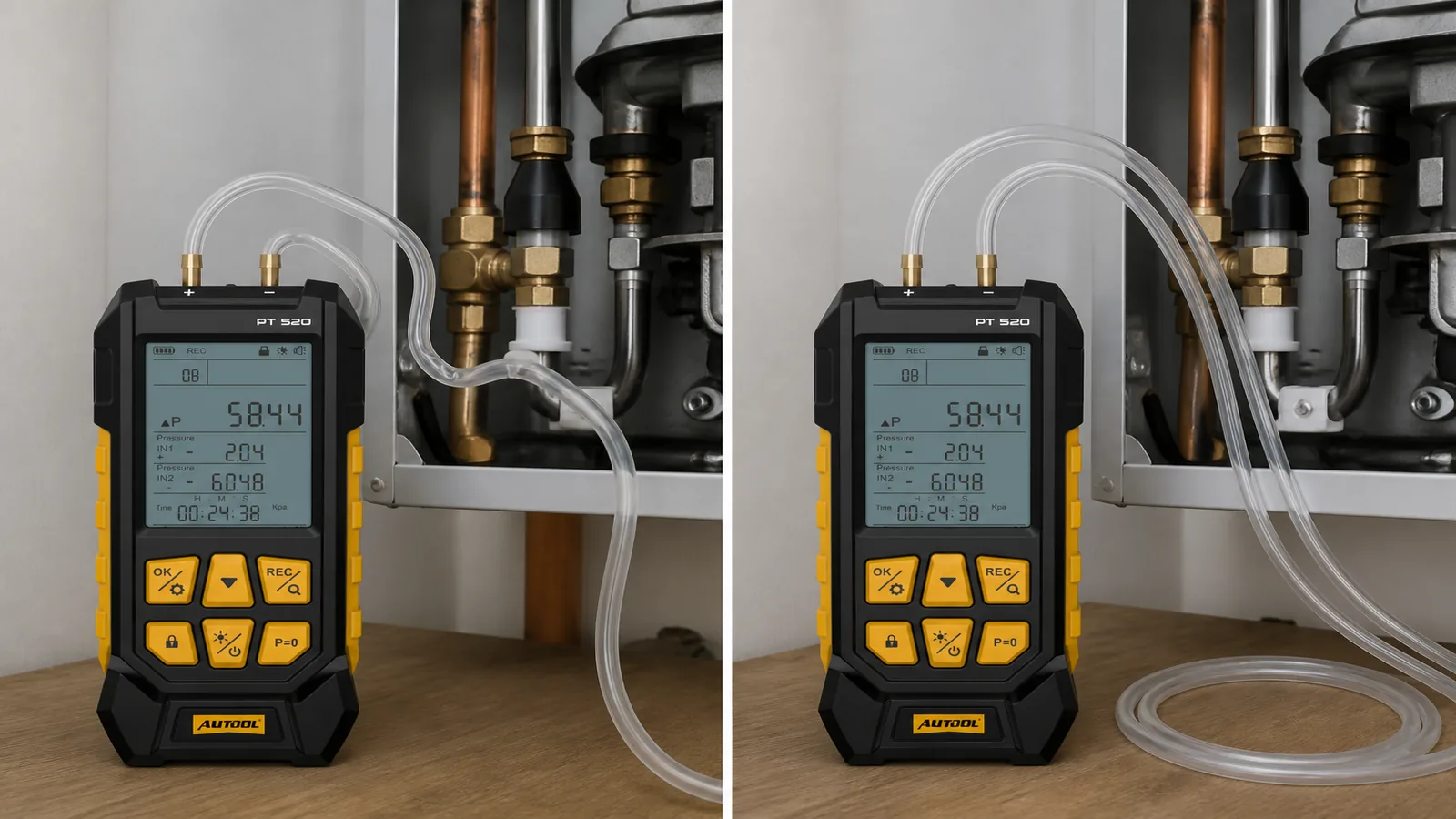
Public listing language for dual-port digital gas / HVAC differential testers such as the AUTOOL PT520 describes a multi-unit display and a working span in the region of −100~200 kPa among other scales. Stay inside the listed range for the job; overrange can invalidate the reading even if a number still appears. Allow the instrument to settle after moving between hot plant rooms and cold vans—heat soak on the sensor and tubing can shift displayed values until temperatures stabilise. Do not treat catalogue accuracy phrases as a substitute for a verified calibration regime.
DIY gas-work boundary
A manometer does not make the user a gas engineer. In Great Britain, only Gas Safe registered engineers appear on the official register for gas work, and legally required gas work must be carried out by a registered engineer. Buying or carrying a digital manometer does not confer Gas Safe registration on the product or the purchaser.
Next step
If you need a dual-port digital gas / HVAC differential pressure tester with multi-unit readout and field kit accessories for UK use, review the current product details for the AUTOOL PT520 listing, including the site’s free UK delivery and 12-month warranty statements.
FAQ
Why do mbar and kPa mix-ups happen so often?
Both units appear in UK HVAC and gas paperwork, and many meters switch units with a single button. Always match the display to the procedure before you record a pass or fail.
How do I spot swapped high and low ports?
Compare the sign and magnitude with what the circuit should show, then reverse the hoses once as a check. A reading that flips predictably usually points to port assignment, not the appliance.
Must I zero every time?
Yes—zero before each meaningful test sequence, especially after changing hoses, altitude of use, or temperature.
Can a homeowner use a digital manometer for UK gas work?
Owning a gauge is not the same as being authorised to do gas work. Where the law requires it, use a Gas Safe registered engineer.